

Introduction
With the digitization of the workplace, both personal and professional tasks now include the sharing of files and data across platforms and devices. Better file transmission methods are more important than ever. Although Bluetooth provided a “sort of” answer to the issue decades ago, it is still sluggish, cumbersome, and sometimes incompatible with sufficiently big data. Modern software has also caught up in an attempt to overcome this little barrier, offering services like Google Drive, Dropbox, OneDrive, and so on. However, their main function is cloud storage. Even if they have significantly improved the convenience of sharing files via Bluetooth, they still fall short of their potential in terms of file interchange.
That’s where SHAREit, a universally applicable solution to this issue, comes in.
Features
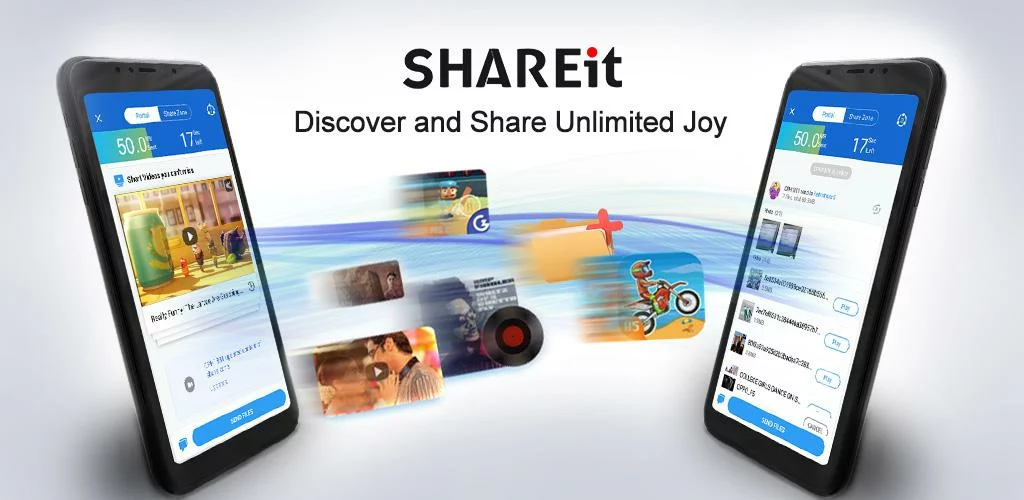
You can share files across a broad range of devices using SHAREit, regardless of their nature. from PCs, tablets, and phones, as well as from a range of operating systems that the software is compatible with, including Windows and MacOS. The nicest part about SHAREit is that it allows you to exchange files much more quickly than with conventional Bluetooth sharing. To transmit files, SHAREit uses the direct wireless hotspot’s speed rather than the low-bandwidth Bluetooth connection. Be aware that wifi hotspots and regular WiFi are not the same thing. The latter, which SHAREit employs, establishes a direct connection with the destination device in a manner that is essentially identical to Bluetooth’s, but far more effective. Not WiFi on the Internet.
Large things like movies, executables, and maybe zip files aren’t as difficult to transmit via this direct connection.
When using cloud-based storage services in the past, there were several difficult procedures you had to do. For example, you would upload the file or files to the storage server, get the share link, send it to the recipient, and then the recipient would need to set aside time to download the file—which, if it’s large, may take a while. Bypassing all of these processes and enabling direct device-to-device sharing is possible with SHAREit. Without going through any intermediaries, the file you want to share is sent straight to the recipient’s device. All of the user’s devices are connected by SHAREit to create a tiny, private network that enables fast and easy data sharing between them at no cost or restriction.
Its lack of universality is the one little drawback it has over conventional Bluetooth. Since almost all modern smart gadgets have Bluetooth, you can transfer files right away without needing to download anything first. As one would expect, SHAREit only permits file sharing between devices that have SHAREit activated and operating. Even yet, you undoubtedly anticipated there would be too many issues with this software the instant you learned about it.
However, since SHAREit works to bring together and support as many platforms as it can, including Windows, MacOS, iOS, Android, and iOs. Use of devices across different platforms may cause issues. Since every platform has its unique set of issues, resolving them might vary greatly depending on the platform and need the use of distinct approaches.
Furthermore flawed is the software itself. It is still glitchy and lacks many user manuals and instructions, while having a “workable” code structure and a somewhat sound idea. Since SHAREit doesn’t provide you with any tutorials or usage instructions, it’s likely that you will be really puzzled the instant you open the program if this is your first time using it. For those of you who love technology, this probably wouldn’t be too much of a deal. However, it can be a complete turnoff for most customers. But basically, everything comes down to initial setup. First things first, make sure your WiFi is configured correctly so that SHAREit can be accessed via the app’s menu.
There are also moments when the app crashes. As I already said, I can assure you that with enough fiddling, it will ultimately function. But it doesn’t imply the route up to that moment would be all wonderful and dandy. I have often had freezes and other issues while attempting to upload data, as have many other individuals. Occasionally, the program completely crashed and needed to be restarted on both devices in order to function. However, be aware that it’s not always reliable; certain files have odd issues and never appear to be able to reach the other device. But they are distinct instances.
Compared to Bluetooth, media transfers on SHAREit are notably faster. Additionally, files—especially documents—are a breeze. However, the program immediately disconnects from the recipient’s hotspot as soon as the file is sent. Therefore, when the process is complete, you must laboriously join again in order to transfer another file. Rinse and repeat. Although it is very inconvenient, at least it is not as slow as using Drive. More than anything, however, right now I’m simply trying to put up with it.
Final Words
Yes, SHAREit does function, that much is certain. I sometimes have to use Drive to transfer files since it is still a long way from being totally dependable. Even though I was able to figure out how to utilize the app after doing some research, not many new users would be able to do the same. They are searching for easy fixes that can be completed in an easy manner, and SHAREit hasn’t yet succeeded in doing so. There is still a lot of work to be done on the code base to address its bugs, especially with relation to platform interaction. As their efforts dwindled, it seems that the developers were attempting to cover as much land as possible, causing their positions to become less firm. Supports for the vast majority of devices are undoubtedly beneficial, but before attempting to support more, they should concentrate on a limited number.